
MOA

WAKIX Increases Levels of Histamine, a Sleep-Wake State Stabilizing Neurotransmitter1,2

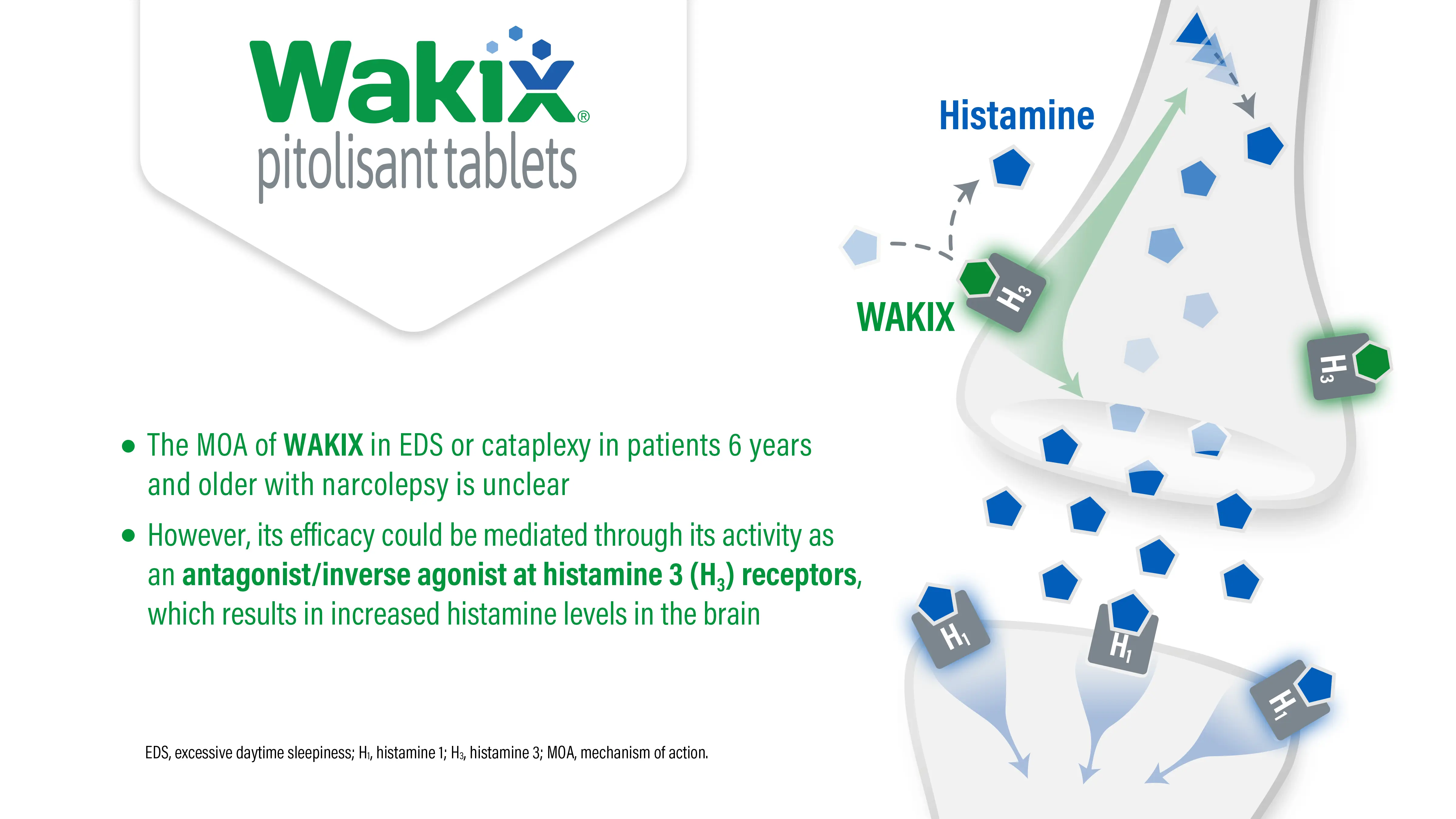
The mechanism of action (MOA) of WAKIX in EDS or cataplexy in patients 6 years and older with narcolepsy is unclear; however, its efficacy could be mediated through its activity as an antagonist/inverse agonist at H3 receptors, which results in increased histamine levels in the brain.
WAKIX is a first-in-class histaminergic treatment for patients with narcolepsy with or without cataplexy (narcolepsy type 1 or narcolepsy type 2)

WAKIX Blocks Histamine From Binding to Presynaptic H3 Autoreceptors3-5

WAKIX Binding to H3 Receptors Increases Histamine Synthesis and Release3,5,6

Histamine Binds to H1 Receptors, Which Increases Communication to Neurons in Brain Regions Important for Sleep and Wakefulness7,8

EDS, excessive daytime sleepiness; H1, histamine 1; H3, histamine 3.

H1 receptors increase neuronal activity, which allows for communication with brain regions important for sleep and wakefulness.2,3,9

H3 receptors help regulate histamine synthesis and release.3 Normally, when synaptic histamine levels are high, histamine binds to H3 autoreceptors to inhibit further synthesis and release of histamine in the brain.3,9

map

Watch a video about the MOA of WAKIX

START PRESCRIBING,
FORMULARY COVERAGE, AND
PRIOR AUTHORIZATION

WAKIX RxCenter for Healthcare Professionals logo

Access resources

»
RxCenter Cta Banner